

- Home
- Blog
Website Audit: What Is It and Why Is It Important?
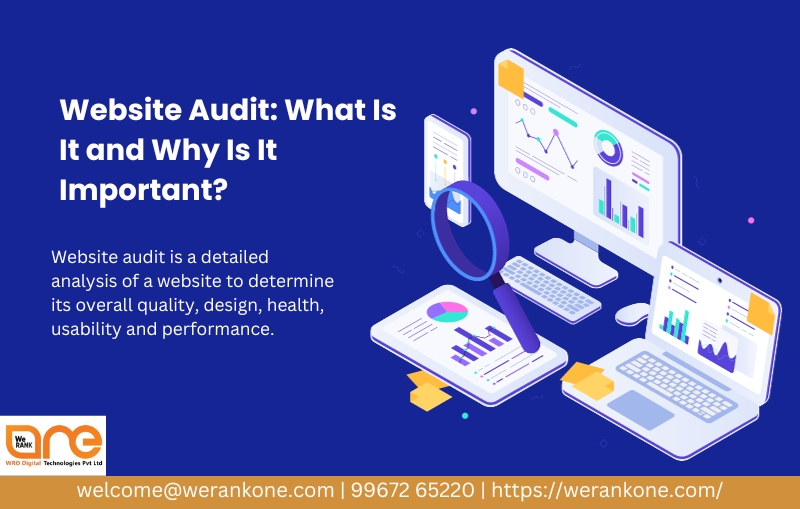
Your company website builds a strong reputation online, and your potential customers may judge your company’s credibility based on it. Therefore, it is necessary to have a compelling, up-to-date website with an enhanced user experience for your audience.
Many businesses fail to build their strong online presence by neglecting the need to audit their website and check the website performance and other valuable insights. This may affect the user experience, decrease in conversion rate, and overall online performance.
So, What Is Website Audit?
A website audit is a detailed analysis of a website to determine its overall quality, design, health, usability, and performance. It includes various aspects of the website, such as website design, technical infrastructure, quality of content, search engine optimization (SEO), user experience, and more. Website audits allow us to make necessary improvements to issues and errors in website design and development while improving its Google ranking and user engagement.
Key Website Audit Types
Every website is unique and has its own challenges that need to be solved. Different types of website audits are designed to improve various areas of the website. These include:
Technical SEO Audit
In this the technical aspects of the website are analyzed to help Google and other search engines crawl, index, and rank pages on your website. It checks metadata, keywords, image optimization, site speed, site structure, URL structure, redirect chains, server errors, XML, and more.
Content Audit
In this audit the website content is evaluated to check its relevance, quality, and effectiveness. This ensures the website content resonates with your brand voice. It also checks its accuracy, freshness, keyword optimization in content, duplication, broken links, and content structure.
User Experience Audit
The user experience (UX) audit helps improve website usability, increase traffic, and drive conversions by focusing on attractive design layout, navigation, call-to-action features, and accessibility.
Mobile-Friendly Audit
This audit examines the usability of the website on mobile devices. It analyzes the custom design, page navigation on mobile, and other mobile-friendly features. It ensures the website is well-optimized for every mobile device and screen size, as the majority of the traffic comes from mobile users.
Security Audit
The security audit analyzed website security settings, SSL certificates, third-party plug-in or tool issues, website platform upgrades, database evaluations, compliance with ADA and WCAG norms, firewall settings, server vulnerabilities, potential threats, copyright issues, unethical practices, and more. It focuses on protecting the website’s reputation, sensitive data, and user information.
SEO Audit
This audit analyzes the website’s performance and SEO. It includes competitive research, off-page SEO (backlinks, domain rights), and SEO elements (meta tags, keywords, and content optimization). The objective is to increase organic traffic, enhance search ranks, and optimize the website for search engines.
Conversion Rate Optimization (CRO) Audit
In this audit, the features such as call-to-action buttons, contact forms, landing pages, and user flows are analyzed for how they convert website visitors into potential customers or leads. This helps in increasing conversion rates and optimizing return on investment (ROI).
Competitive Audit
This audit report compares your website with competitors’ websites based on website design, content SEO, keywords, performance, traffic, and more. This allows you to make improvements to your website and gain a competitive edge.
What Are The Benefits Of Website Audit?
- Website audits enhance user experience by resolving website page loading speed, navigation, and mobile-friendliness issues for increased conversions.
- Optimizing your website via audits elevates SEO ranking and increases organic traffic.
- Identifying website gaps via audits leads to improved user experience and an increase in conversion rates.
- Website audits enhance content quality, which is important for engaging and converting potential customers and leads.
- Regular website audits ensure alignment with evolving Google algorithms, boosting SERP visibility.
- Audits protect from potential cyber threats and improve credibility among the visitors.
- A website audit enables you to stay ahead of the competitive digital landscape by adapting latest trends and best practices.
Conclusion
You may now know how important a website audit is for your online growth, but you may wonder when you should get it done. According to our expert SEO company, your website must be audited quarterly or annually, depending on the number of pages in your website. Also after making the website live, you can check for any errors and fix them immediately. Get a free SEO audit for your website from the best SEO company in Navi Mumbai and learn how our experts can assist you with your digital journey.
Call Anytime (Toll Free)
+91 84548 60180, +91 99672 65220
Send Email
info@wrodigital.com
Newsletter
-
 Grow Your Business with Digital Marketing Agency in Navi Mumbai
 -
 Why Chat GPT Is A Risk For SEO Content?
 -
 SEO Agency in Navi Mumbai
 -
 Stay Ahead of the Curve: Mastering Voice Search Optimization in 2023
 -
 Why Does Your Business Need Social Media Marketing?
 -
 Top Benefits of Web Development for Business
 -
 5 Essentials of a 360-Degree Digital Marketing Strategy for a Restaurant Business
 -
 Why is the Digital Marketing Approach Necessary for Healthcare Industry?